
The Muslim Youth League (MYL) is the official youth wing of the Indian Union Muslim League (IUML). Established in 1973, MYL has its headquarters in New Delhi and state committees across India that organize young members around IUML’s political and social agenda. As a youth organization, MYL mobilizes students and young professionals who endorse the IUML’s principles, channeling their energy into constructive political engagement and community service.
Vision
The MYL’s vision reflects its parent party’s commitment to minority rights, democracy and secularism. In line with the IUML’s founding charter – which emphasizes “achieving the constitutional rights of Muslims, other backward and minority people” and stands for the “integrity of the nation” under a motto of “secularism and communal harmony” – the Muslim Youth League strives to empower young people through education, leadership and civic awareness.
Mission
MYL promotes values of social justice, communal harmony and inclusive development, encouraging youth to work for the welfare of all communities. It aims to develop a new generation of leaders who are both proud of their identity and committed to India’s democratic framework.
Ideology
By engaging young Indians in secular democratic politics, and community service, the Muslim Youth League aims to strengthen the socio-political fabric of India and ensure that minority youth are active, informed and inclusive citizens. Its inclusive, empowerment-driven approach makes it a vital bridge between the youth and the broader goals of democracy, justice and communal harmony advocated by the Indian Union Muslim League.
Our Inspiration
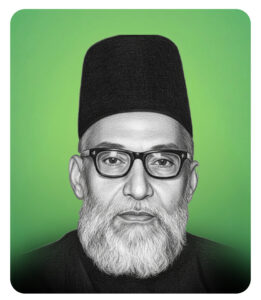
Quaid-e-Millath Muhammed Ismail Sahib
In the hostile aftermath of Partition, when Muslim political assertion was criminalised, re-organising the Muslim League became an act of defiance and dignity. Quaid-e-Millath Muhammed Ismail Sahib, inspired by Sahib Jamal Muhammed, rebuilt the League in the Madras Presidency, forged alliances with Periyar in Tamil Nadu, and found strong support in Malabar. Founder President of the Indian Union Muslim League, he served Indian Muslims for over 25 years as Opposition Leader in the Madras Assembly, a member of the Constituent Assembly, the League’s first Rajya Sabha member, and a three-time Lok Sabha MP—leaving a lasting imprint on India’s democratic and legislative life.
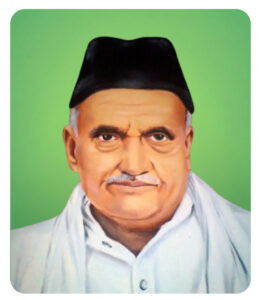
K. M. Seethi Sahib
K.M. Seethi Sahib emerged as a towering leader—visionary statesman, eminent lawyer, writer, and gifted orator—revered in British India as Seethi Sahib Bahadur. An early Muslim League leader and former Speaker of the Kerala Legislative Assembly, he devoted his life to restoring dignity and confidence to a community shattered by Partition, especially the poor and marginalised. Founder of Chandrika daily, and a legislator in the Kochi, Madras, and Kerala Assemblies, he profoundly shaped Kerala’s political life.
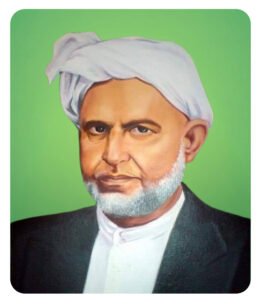
Sayid Abdurahman Bafakhi Thangal
Bafakhi Thangal was a pivotal force in popularising and expanding the Muslim League across Kerala and beyond, serving successively as Kozhikode Town President, Malabar District President, Kerala State President, and ultimately All India President. A visionary who helped shape Kerala’s coalition politics, he played a key role in the formation of the UDF and unified diverse ideological currents within the Muslim community on a single political platform. Revered also as a leader of the Samastha Kerala Jamiyathul Ulama, he championed social, political, and educational empowerment. With his wisdom in preserving Muslim political autonomy and strategic pursuit of power, he strengthened the community and earned the enduring title of Qaidul Qoum among Kerala’s Muslims.
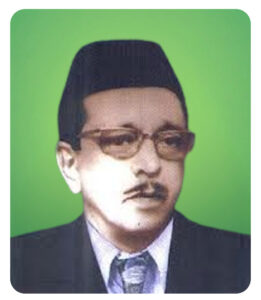
P. M. S. A. Pookoya Thangal
Pookoya Thangal’s political journey began as President of the Ernad Taluk Muslim League, eventually rising to become the State President of the IUML Kerala. His commitment to justice and public service was evident throughout his life. During the Hyderabad Action of 1948, he was imprisoned for two weeks for standing firm in his convictions. He also served as President of the Malappuram District Muslim League, shaping its organisational structure in its early years.
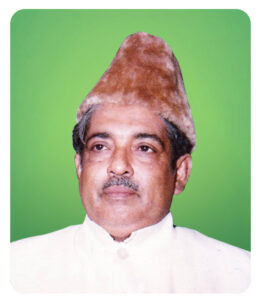
C. H. Muhammed Koya
Muhammed Koya Sahib, former Chief Minister of Kerala, was prominent among the leaders of the Indian Union Muslim League. He has been recognized as ‘Chief architect of modern-day Malabar’. Born to a humble background, he rose to the ranks of the Muslim League through Muslim Students’ Federation. Known for his administrative skills, CH has masterminded the educational and economic mobility of the community in Kerala which stands truly apart from Muslims elsewhere in India. He asked the Muslims to fight poverty and send generations to school. Appealed students to educate and enlighten themselves to foster a sense of dignity that will never make them feel ashamed of their identity as a Muslim.
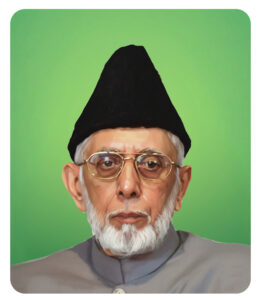
G. M. Banatwala
G. M. Banatwala was among the foremost leaders of the Indian Union Muslim League and a powerful parliamentary voice for Indian Muslims. Beginning his public life in the Maharashtra Municipal Corporation, he rose to serve as General Secretary and President of the Mumbai Muslim League before being elected to the Maharashtra Assembly in 1967, where he served for a decade. In 1977, he entered the Lok Sabha from Ponnani, Kerala, representing the constituency for multiple terms and earning wide respect as one of Parliament’s most incisive speakers. A member of the All India Muslim Personal Law Board and the All India Muslim Majlis-e-Mushawarat, Banatwala consistently championed educational empowerment, minority and citizenship rights, freedom of religion, and Muslim Personal Law, while firmly opposing draconian laws, state excesses, and communal violence. As National President of the IUML, a prolific writer, and an intellectual of rare constitutional depth, he embodied principled politics, scholarship, and dignified public service.
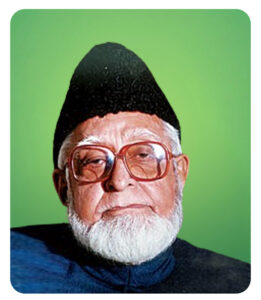
Ibrahim Sulaiman Sait
Ibrahim Sulaiman Sait was a towering national leader, parliamentarian, and one of the most influential Muslim political voices in post-Independence India. Elected to the Lok Sabha multiple times from 1967 onward, he became widely respected for his principled stands, clarity of thought, and fearless advocacy for civil rights and social justice. Sait played a decisive role in shaping the party’s democratic character and national outlook. His integrity, scholarship, and unwavering commitment to the marginalised continue to inspire generations of political workers.
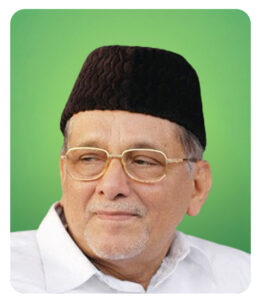
Sayyid Muhammed Ali Shihab Thangal
Sayyid Muhammed Ali Shihab Thangal was a revered spiritual, social, and political guide whose leadership shaped the identity and direction of the IUML for nearly three decades. Taking charge at the age of 39, he became a unifying force whose humility, wisdom, and moral authority earned deep respect across communities. Under his stewardship, the IUML strengthened its commitment to secular values, social harmony, education, and community upliftment. His calm, principled leadership and ability to navigate complex political landscapes left a lasting imprint on Kerala’s public life, making him one of the most influential figures in IUML’s history.